

What Happens If You Die Without taking care of your family
 "What Happens If You Die Without taking care of your family")
Most people know they should have a will. Yet thousands of Ontario residents die every year without one.
Some simply never got around to preparing a will. Others assume their spouse will automatically inherit everything. Still others believe their children will simply divide their estate fairly.
Unfortunately, that is not how Ontario law works.
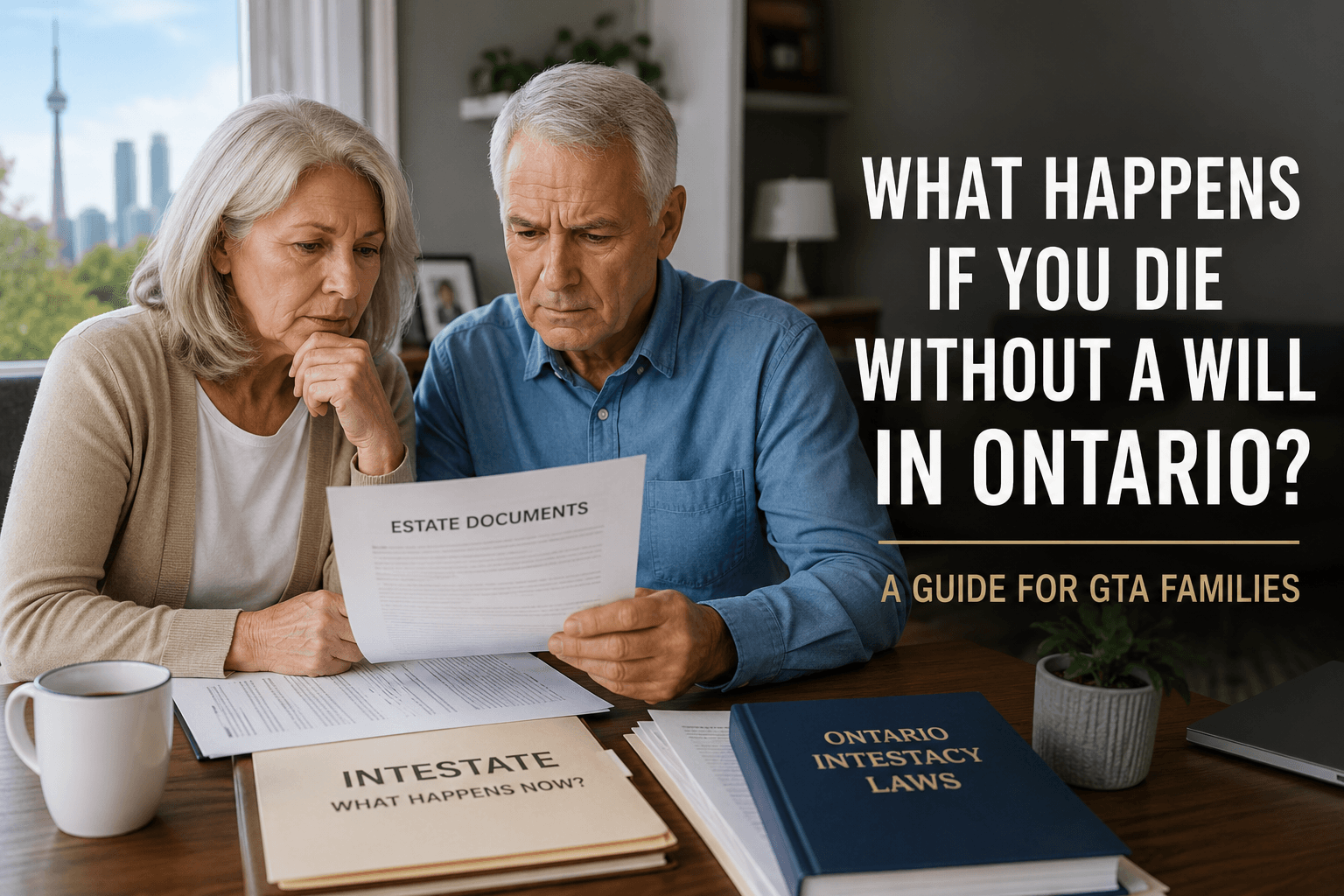
If you die without a valid will in Ontario, you are considered to have died "intestate." In that situation, the Government of Ontario—not you—decides how your estate will be distributed.
For families throughout Toronto, Mississauga, Brampton, Vaughan, Markham, Richmond Hill, Oakville, Burlington, Ajax, Pickering, Whitby, Oshawa, Aurora, Newmarket, and surrounding GTA communities, understanding the consequences of dying without a will is an important step toward protecting loved ones and preserving family harmony.
What Does "Dying Intestate" Mean?
The term "intestate" simply means that a person dies without a legally valid will.
When this happens, Ontario's Succession Law Reform Act establishes who receives the deceased person's assets and who has the authority to administer the estate.
The deceased person's verbal wishes, handwritten notes, family expectations, or informal promises may have little or no legal effect.
Instead, the estate is distributed according to a predetermined formula established by provincial legislation.
Why a Will Matters
A will allows you to:
- Decide who inherits your assets
- Appoint an executor
- Provide for your spouse
- Protect children and grandchildren
- Support charities
- Address blended family situations
- Reduce family disputes
- Clarify your wishes
Without a will, many of these decisions are removed from your control.
Who Inherits If There Is No Will?
The answer depends on your family circumstances.
Scenario 1: Married With No Children
If you are legally married and have no children, your spouse generally inherits the entire estate.
In this situation, the law is relatively straightforward.
However, common-law spouses are treated differently.
Scenario 2: Married With Children
Ontario law currently provides a "preferential share" to the surviving spouse.
The surviving spouse receives the first portion of the estate, currently up to $350,000.
The remainder is then divided between the spouse and children according to a formula established by law.
For larger estates, this may produce results that differ significantly from what the deceased intended.
Scenario 3: Common-Law Relationship
This is one of the biggest surprises for many Ontario residents.
Common-law spouses do not automatically inherit under Ontario intestacy legislation.
Even if a couple has lived together for many years, the surviving partner may not receive the same protections as a married spouse.
Without a will, the surviving partner may need to pursue costly legal claims against the estate.
This is one reason estate planning is particularly important for common-law couples.
Scenario 4: Single With Children
If there is no surviving spouse, the estate generally passes equally among the children.
If a child has already died, that child's share may pass to their own children.
Scenario 5: No Spouse and No Children
If there is no spouse or children, the estate may pass to:
- Parents
- Siblings
- Nieces and nephews
- More distant relatives
The law follows a prescribed order of inheritance.
Scenario 6: No Known Relatives
If no eligible relatives can be located, the estate may ultimately pass to the Government of Ontario.
Most people are surprised to learn this is a possibility.
What Happens to Your Home?
For many GTA residents, the family home represents the largest asset in their estate.
The treatment of the home depends on:
- Ownership structure
- Whether there is a surviving spouse
- Whether children survive
- Whether the property is jointly owned
Joint ownership arrangements may allow property to pass outside the estate.
However, every situation is unique, and assumptions can lead to costly mistakes.
Proper estate planning can help ensure your intentions are clearly documented.
Who Becomes the Estate Trustee?
When there is a will, the will normally names an executor.
Without a will, there is no executor.
Someone must apply to the court to become the Estate Trustee Without a Will.
This process can create:
- Delays
- Additional legal expenses
- Administrative complications
- Family disagreements
The court ultimately determines who receives authority to administer the estate.
Family Disputes Are More Common Than Many People Realize
Many families believe everyone will cooperate after a loved one's death.
Unfortunately, disagreements frequently arise regarding:
- Distribution of assets
- Family heirlooms
- Real estate
- Personal belongings
- Executor appointments
A properly drafted will often reduces uncertainty and helps prevent disputes before they begin.
Blended Families Face Special Risks
Second marriages and blended families are increasingly common throughout Ontario.
Without a will, estate distribution may not reflect the deceased person's intentions.
For example:
- Stepchildren may receive nothing.
- Children from a first marriage may receive less than expected.
- Surviving spouses may face financial uncertainty.
These situations can become emotionally and financially complicated.
Estate planning allows individuals to create arrangements tailored to their family's specific circumstances.
What About Minor Children?
Parents of minor children face another important consideration.
A will allows parents to express their wishes regarding guardianship.
Without a will, the court may need to determine who should care for minor children if both parents are deceased.
While the court always acts in the child's best interests, most parents prefer to provide guidance through a properly prepared will.
The Hidden Cost of Dying Without a Will
Many people postpone estate planning because they believe it will be expensive.
Ironically, failing to prepare a will often creates far greater costs.
Potential consequences include:
Legal fees
Court applications
Estate administration delays
Family disputes
Unintended inheritances
Increased stress for loved ones
The cost of creating a will is typically modest compared to the financial and emotional costs that can arise when there is no plan.
Powers of Attorney Are Equally Important
Estate planning is not only about what happens after death.
A complete estate plan should also address incapacity.
Many Ontarians choose to prepare:
Continuing Power of Attorney for Property
Allows someone you trust to manage financial affairs if you become incapable.
Power of Attorney for Personal Care
Allows someone you trust to make healthcare and personal care decisions.
Without these documents, family members may need to seek court authority to act on your behalf.
Why GTA Families Should Review Their Estate Plans
Many residents throughout the Greater Toronto Area have experienced significant life changes in recent years:
- Retirement
- Home value increases
- Blended families
- Grandchildren
- Caring for aging parents
- Changes in financial circumstances
These events often create a need to review and update estate planning documents.
Even individuals who already have wills should periodically ensure their documents continue to reflect their wishes.
Estate Planning Provides Peace of Mind
At its core, estate planning is not about paperwork.
It is about protecting the people you care about most.
A properly prepared will can:
- Provide clarity
- Reduce uncertainty
- Protect vulnerable family members
- Minimize disputes
- Preserve family relationships
Most importantly, it allows you—not the government—to decide how your estate will be handled.
Conclusion
If you die without a will in Ontario, provincial legislation determines who inherits your estate and who administers it.
For some families, the outcome may be acceptable.
For many others, it may be very different from what they intended.
A professionally prepared will provides an opportunity to protect your family, clarify your wishes, and reduce future complications.
For many Ontario residents, creating or updating a will is one of the most important steps they can take to secure their legacy.
Frequently Asked Questions
What does intestate mean?
Intestate means dying without a legally valid will.
Does my spouse automatically inherit everything?
Not always. The answer depends on whether you are legally married, whether you have children, and the value of the estate.
Does a common-law spouse automatically inherit?
Generally, no. Common-law spouses do not have the same automatic inheritance rights as married spouses under Ontario intestacy laws.
Who becomes the executor if there is no will?
There is no executor. Someone must apply to the court to become Estate Trustee Without a Will.
Can the government inherit my estate?
Yes. If there are no eligible relatives, the estate may ultimately pass to the Province of Ontario.
Serving Families Across the Greater Toronto Area
Upper Canada WILLS & Estates Ltd. assists clients throughout:
- Toronto
- Mississauga
- Brampton
- Vaughan
- Markham
- Richmond Hill
- Oakville
- Burlington
- Ajax
- Pickering
- Whitby
- Oshawa
- Aurora
- Newmarket
Virtual consultations are available across Ontario.
Need to Review Your Estate Plan?
If you do not currently have a will, or if your existing documents have not been reviewed in several years, now may be the right time to consider updating your estate plan.
Upper Canada WILLS & Estates Ltd. connects Canadians with experienced estate planning lawyers who can assist with wills, powers of attorney, and related estate planning matters.